
How Much Is That Dirt Costing You? Modelling Non-Uniform Albedo for Bifacial Yield
Albedo boosters lose their edge when they get dirty. Snow melts unevenly. Ground cover varies across every site. An independent study validates SunSolve's ability to model these non-uniform albedo conditions against field measurements — and the yield impact is larger than most engineers assume.
· Ben Sudbury · research · 10 min read
Albedo boosters lose their edge as they get dirty. But how much energy does that cost, and when does it pay to clean them? A conventional yield model can’t tell you — it assumes a single albedo value across the entire ground surface. An independent study has now shown that SunSolve can see what that assumption misses.
Your Default Albedo Could Be a $400K Mistake
In the monofacial era, the albedo setting in PVsyst didn’t matter much for utility-scale projects. Whether you entered 0.20 or 0.25, the difference in yield was very small — there was no real need to worry about it.
Bifacial changed that. PVsyst introduced a separate ground albedo input specifically for the bifacial system definition — and this number matters. Rear-side irradiance now contributes 5–10% of total energy on a typical tracker system, and it’s driven almost entirely by what’s on the ground between the rows. A parameter that nobody used to worry about is now one of the most sensitive inputs in the model.
And ground conditions are never uniform: bare soil next to gravel, vegetation between rows, clean booster strips next to dirty ones, snow patches alongside clear ground. PVsyst has no mechanism to represent this — you enter one number and it applies everywhere.
SunSolve models the ground as it actually exists. Its 3D ray-tracing engine places different materials with different reflectances across the surface, traces how light interacts with each one, and carries the resulting non-uniform irradiance through to the full electrical circuit solution.
Because SunSolve’s materials are wavelength-dependent, it also accounts for the fact that different surfaces reflect different parts of the spectrum — grass reflects strongly in the near-infrared while absorbing visible light, snow reflects broadly, and white reflective sheets have their own spectral signature.
An Independent Validation
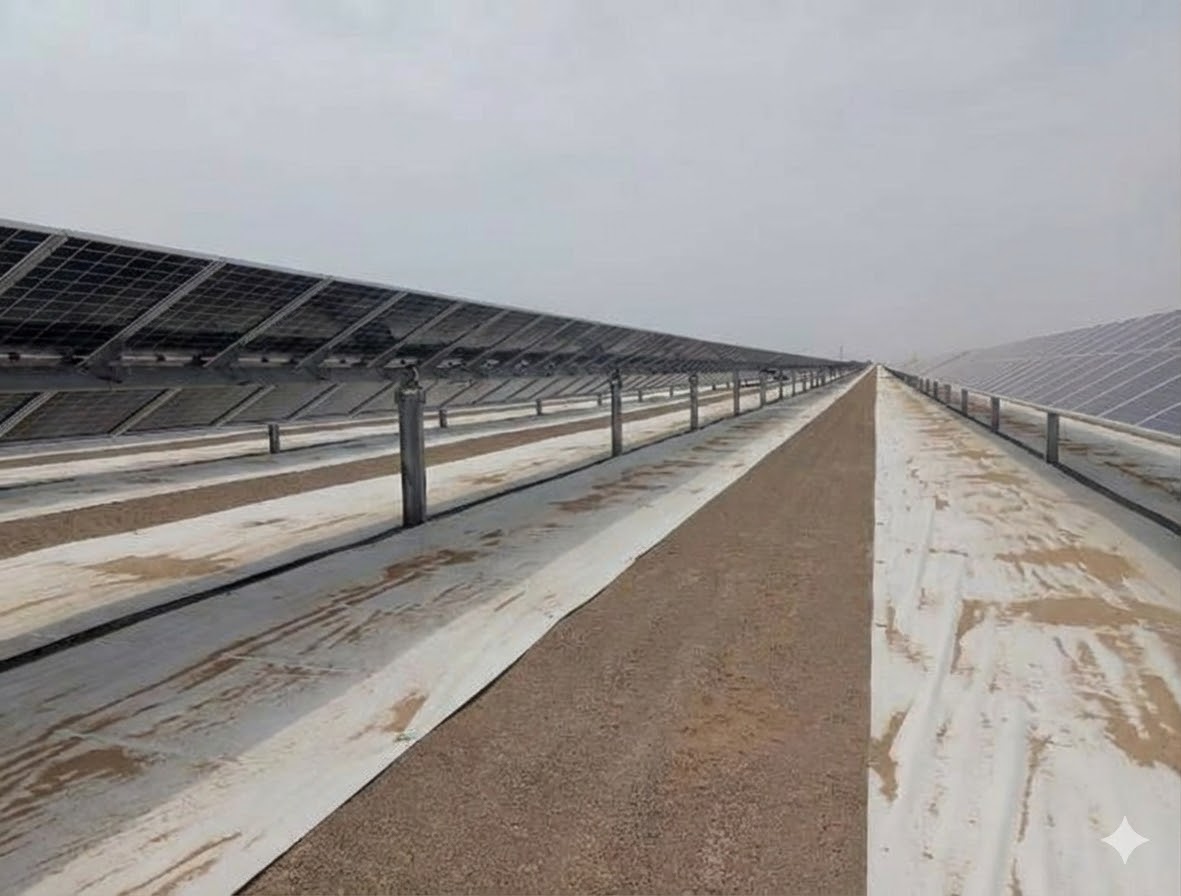
A recent masters thesis from KTH Royal Institute of Technology provides independent validation of this capability. In “Ray-Tracing Simulation and Analysis of Bifacial PV with Multi-Albedo Surfaces”, Mohammed Nabeel Humayoon Kabir compared SunSolve simulations against field measurements from a utility-scale fixed bifacial system in France, fitted with albedo boosting sheets of varying widths.
The experimental setup was straightforward: measure the energy output of a bifacial system with albedo boosters at widths of 3, 4, 5, and 6 metres under specific inverter MPPTs, and compare the measured gains against SunSolve’s predictions.
The study was conducted while the author was working at Feedgy, a SunSolve customer, but it was not commissioned or supervised by SunSolve — so we were very interested to see the results once they were presented in Kabir’s thesis.
Key Findings
The results are clear and consistent:
- Energy output increases with albedo booster width. Both measured and simulated energy rose as the reflective surface widened from 3 to 6 metres. Wider boosters provide more rear-side irradiance, leading to improved bifacial performance.
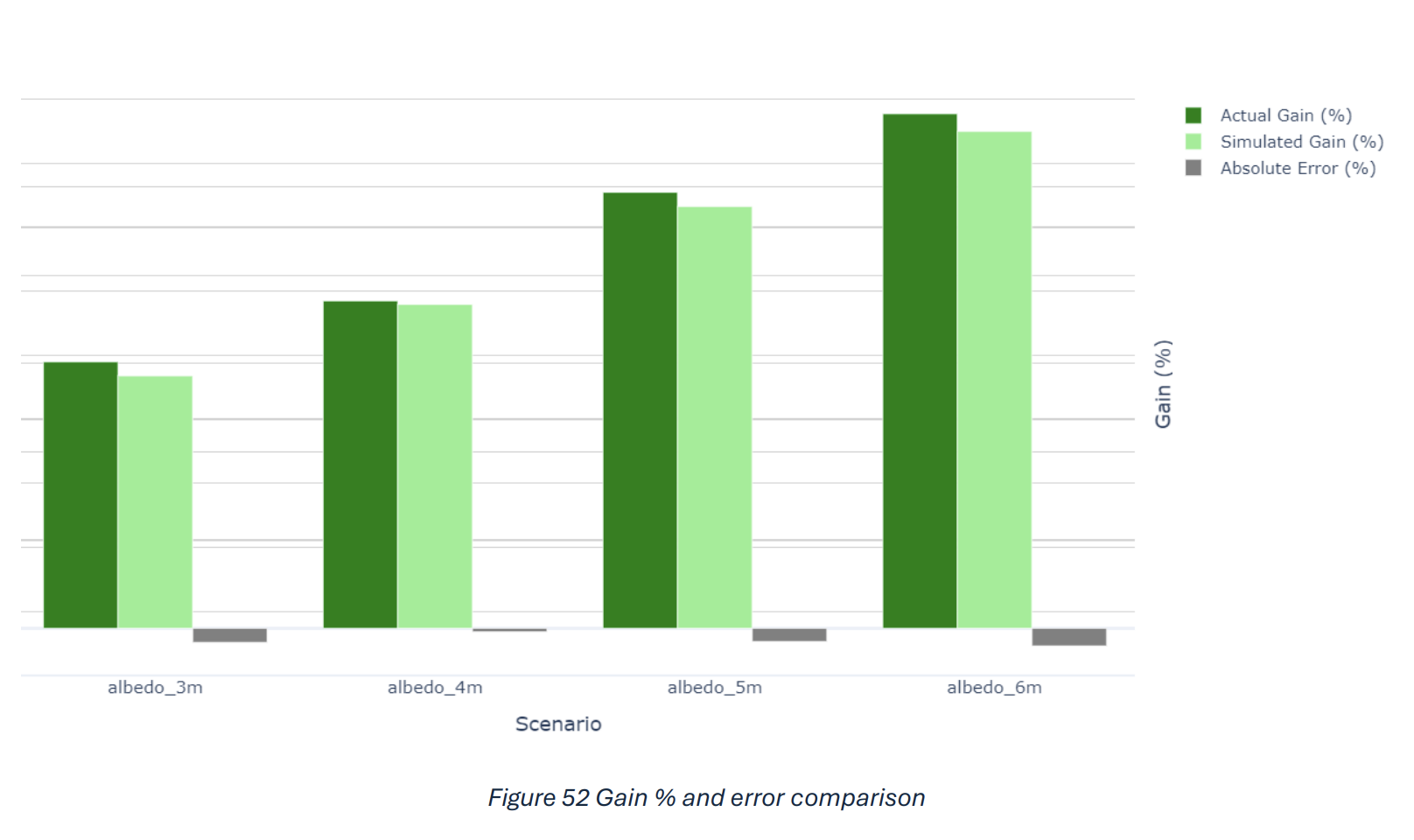 Figure 52 from Humayoon Kabir, 2025: Gain percentage and absolute discrepancy between measured and simulated results for albedo booster widths from 3 to 6 metres. The simulation consistently tracks the measured gains with an absolute discrepancy below 0.20%.
Simulated gains closely track actual measurements. The gain percentages from SunSolve rise with albedo width, matching the trend observed in the field data. The simulation captures the relative impact of wider boosters accurately.
SunSolve models the physics that matter. The study concludes that SunSolve effectively models the relative impact of albedo boosters on bifacial gain, even accounting for the inevitable differences between simulation and real-world field conditions.
As Kabir concludes: “The simulated gains track the actual values closely, reflecting SunSolve’s effectiveness in modeling the relative impact of albedo boosters.”
Beyond Boosters: Where Non-Uniform Albedo Matters
Albedo boosting sheets are just one case where ground reflectance varies spatially. The same modelling capability applies wherever the ground beneath a solar plant is not uniform — which, in practice, is everywhere:
- Snow cover: After a snowfall, some inter-row areas may be covered while others remain clear, creating alternating strips of high and low reflectance.
- Partial soiling: Dust, mud, and organic material accumulate unevenly across a site. Regions near access roads, drainage paths, or vegetation may have very different reflectance properties.
- Mixed ground cover: Many sites have a mix of gravel, bare soil, vegetation, and concrete pads, each with different albedo characteristics.
- Cleaning patterns: When albedo boosters or ground surfaces are cleaned, some sections may be fresh while others remain degraded — creating the same spatial variation.
- Edge effects: Rows at the boundary of a plant may see very different ground conditions (e.g., adjacent grassland or roads) compared to interior rows.
In every one of these cases, a uniform albedo assumption misses the real distribution of rear-side irradiance, which in turn affects both the total energy forecast and the electrical mismatch between cells receiving different amounts of light.
What Does This Mean at Scale?
To ground this in numbers: when SunSolve models a site with mixed ground surfaces, it resolves wavelength-dependent reflectance for each material and produces an effective near-field albedo that accounts for both the spatial layout and the spectral response of the cells. For two realistic ground scenarios on the same system, SunSolve calculated effective albedo values of 0.244 and 0.220 — a difference of just 0.024 that produced a 0.5% change in specific yield.
That may sound small, but scale it up to a 1 GWDC plant at a typical tracker site:
| Albedo = 0.244 | Albedo = 0.220 | |
|---|---|---|
| Annual generation | ~1,909 GWh | ~1,899 GWh |
| Annual revenue at $40/MWh | ~$76.4M | ~$76.0M |
Difference: ~$400K/year — from a single input being 0.024 off.
These are indicative numbers from one site, and the actual impact depends on system design, location, ground conditions, and PPA terms. The point is that a parameter nobody used to worry about now carries real financial weight, and a default that ignores spatial variation introduces a quantifiable bias.
Why PVsyst Has Two Albedo Settings
There are two physically distinct types of ground albedo that affect a PV system, and PVsyst has a separate input for each. In both cases, PVsyst defines albedo as the ratio of re-emitted to received irradiance, assuming Lambertian (diffuse) re-emission.
Near-field albedo is the reflectance of the ground directly between and beneath the module rows. For bifacial systems, this drives rear-side irradiance — every row sees the ground below it, and even small changes in this value have a measurable effect on yield. In PVsyst, this is the Ground albedo setting in the Bifacial dialog.
Far-field albedo is the reflectance of the terrain surrounding the PV plant. Light reflected from this distant ground contributes to front-side irradiance through the transposition model. In a utility-scale plant with many rows, however, only the front row has a clear view of the far-field ground — interior rows are shielded by the rows in front. The effect on total yield is negligible. In PVsyst, this is the Project albedo in Project Settings, and it has been available for decades.
Both can be set as yearly or monthly values. In the monofacial era, only the far-field project albedo existed, and it barely mattered for utility-scale. The near-field ground albedo is the one that now carries real financial weight — and it’s the one this post is about.
Why This Matters in an IE Review
If you’re delivering bankable yield assessments, there’s a practical reason to care about this beyond the physics: independent engineers are increasingly scrutinizing bifacial inputs.
When the albedo setting barely affected the monofacial result, no one questioned the ground assumption. But as bifacial systems now dominate new installations and rear-side contributions reach 5–10% of total yield, the ground albedo is under a spotlight. An IE reviewing your report will ask: how was this value determined? If the answer is “PVsyst default” and the site clearly has non-uniform ground conditions, that’s a flag — and it can lead to requests for additional justification, revised assumptions, or haircuts to the yield forecast.
The engineers and consultancies who are already using site-specific bifacial inputs have a simpler story to tell in review: the ground albedo was determined by physics-based ray tracing of the actual ground conditions. That’s a defensible, auditable basis — the kind that survives IE scrutiny without follow-up questions.
Getting a Defensible Albedo Number Into PVsyst
The natural reaction is: why not just measure the albedo with an albedometer?
An albedometer measures the integrated response of everything on the ground beneath it — but it gives you one number at one point. The ground varies spatially, and each cell sees a different weighted mix of surfaces. The instrument also responds to wavelengths that silicon cells can’t use — so grass, for example, looks more reflective to the sensor than it is to the cell.
Even with perfect measurements everywhere, you’d still need to convert them into the single effective ground albedo that PVsyst’s bifacial model expects. That conversion depends on view factors, angular effects, and electrical mismatch — it’s inherently a modelling problem. That said, albedometer readings are valuable as inputs: you can use them to calibrate the material properties in SunSolve and improve the fidelity of the simulation.
But there’s also a timing issue: at the forecasting stage, when the yield report is needed for financing, the ground may not be in its final state. You can’t measure what doesn’t exist yet.
So the practical question is: how do you replace a default with something better, without changing your PVsyst workflow?
SunSolve’s PVsyst Factors procedure takes all of the spatial non-uniformity and wavelength dependence modelled by the ray tracer and distils it into a single adjusted albedo value — one number that captures the net effect of the real ground conditions and goes directly into PVsyst. Strips of white reflective material next to bare soil, snow patches adjacent to clear ground, mixed vegetation and gravel — all of it is resolved by SunSolve and boiled down to a site-specific, defensible figure for your PVsyst report.
Your PVsyst workflow doesn’t change. You still build your model in PVsyst, you still generate the same reports. The only difference is that one critical input — the ground albedo — now has an auditable, physics-based justification behind it rather than a default.
This approach builds on the methodology validated in collaboration with Array Technologies and CFV Solar, which established the SunSolve procedure as “the foundation for bankable, real-world modeling best practices for bifacial power plants.” Since 2020, SunSolve simulations have been used by hundreds of projects worldwide to generate the bifacial inputs that PVsyst requires — and the adjusted albedo is generated as part of the same process.
Conclusion
In the monofacial era, PVsyst’s far-field project albedo barely mattered for utility-scale systems. Now, with the near-field ground albedo driving rear-side irradiance, it’s one of the most sensitive parameters in the model — and an independent study has confirmed that non-uniform ground conditions produce measurable, predictable effects on energy yield.
The good news is that accounting for this doesn’t require a new workflow. SunSolve generates a defensible, site-specific ground albedo value that slots directly into PVsyst’s bifacial dialog in under a minute. Whether the non-uniformity comes from dirty boosters, snow, mixed ground cover, or partial soiling, the result is the same: one justified number that replaces a default, survives IE review, and reveals an impact that conventional tools simply can’t see.
If you’d like to see what the adjusted albedo looks like for one of your projects, contact us for a supported trial — we’ll run it with you.