
How 5B Used Physics-Based Modelling to Unlock Hidden Yield in the Maverick
Conventional yield tools couldn't capture the performance of 5B's innovative Maverick mounting system. By working together with SunSolve, 5B uncovered two separate 1–2% yield uplifts — improvements that were invisible to standard modelling — and gained the insights to drive their next-generation design.
· Ben Sudbury · 5 min read
When your hardware innovation breaks the assumptions built into standard modelling tools, the value of that innovation becomes invisible to your customers. 5B faced exactly this challenge with the Maverick — and SunSolve’s physics-based approach let them see what conventional tools were missing.
The Maverick: Innovation That Standard Tools Can’t See
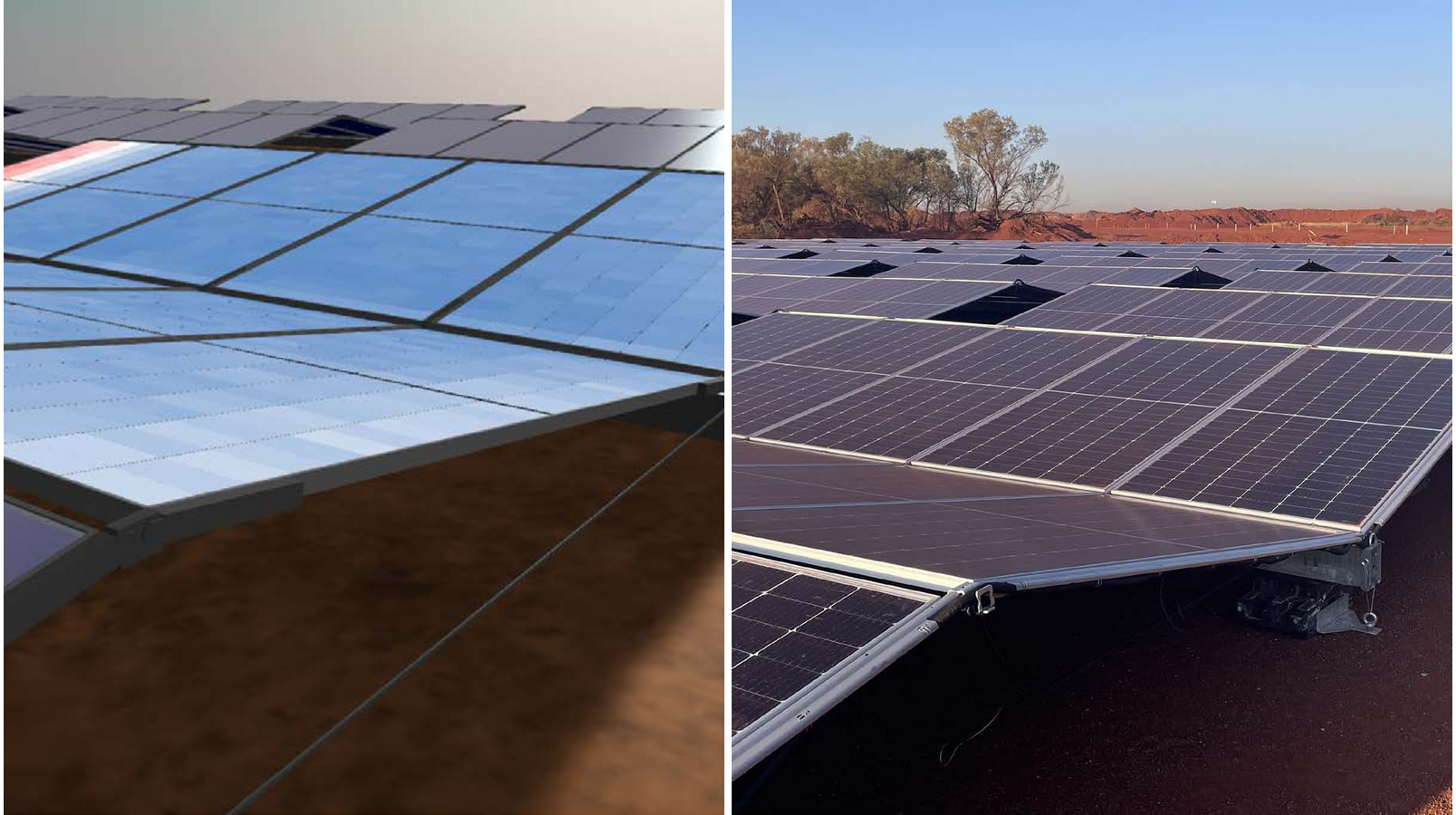
5B is an Australian solar pioneer that developed the Maverick — a prefabricated, pre-wired east-west-facing ground mount that unfurls on-site in a concertina pattern, enabling rapid, highly automated deployment. It’s designed for harsh, remote environments where speed of installation and minimal maintenance are critical advantages.
When 5B was evaluating the Maverick for a proposed multi-gigawatt project in Northern Australia, they turned to conventional yield modelling tools like PVsyst. The problem was clear: these tools are not well suited to assess innovative mounting systems like the Maverick. A more sophisticated modelling approach was required.
The Maverick’s geometry — alternating east- and west-inclined modules sitting low to the ground — creates optical and thermal interactions that fall outside the assumptions of standard modelling software. Light reflects between module surfaces. Wind passes beneath the low-slung structure, cooling the modules. The rear-side irradiance pattern differs fundamentally from that of a traditional tracker or fixed-tilt system, making standard bifacial models unreliable.
None of this could be captured by tools built for standard, uniform configurations.
The Cost of Invisible Value
For 5B, this wasn’t just an academic problem. On a multi-gigawatt project, even a 1% yield forecasting error can mean hundreds of millions of dollars in lost revenue over the project lifetime. If the modelling tools used by developers and financiers couldn’t see the Maverick’s advantages, those advantages effectively didn’t exist in the project economics.
As David Griffin, CEO of 5B, put it:
“The SunSolve process, using ray-tracing, provides the level of precision that’s required — for multi gigawatt-scale projects, in particular. If there’s a 1% error, it’s going to have a much bigger impact in dollar terms on a multi-gigawatt scale project. These errors become very, very impactful. Trying to resolve them is worth a lot of money.”
Working Together to Model What Others Can’t
In collaboration with 5B’s engineering team, SunSolve modelled the Maverick system using project-specific site conditions for the proposed Northern Australia site. The result was a detailed 12-month simulation that resolved the optical, electrical, and thermal complexities for every hour of the year.
The modelling revealed two distinct yield uplifts that conventional tools had missed entirely.
Uplift 1: Bifacial Gain That Was Always There (1–2%)
The common assumption — and what PVsyst would have predicted — was that the Maverick’s low ground clearance meant zero bifacial contribution. SunSolve’s ray-tracing analysis proved this wrong.
By modelling how irradiation actually interacts with the front and rear of the modules and the mounting structure, including the light landing between the rows of Mavericks, SunSolve revealed a bifacial gain of 1–2% — where standard tools had predicted zero. This gain was inherent in the Maverick’s design but had been invisible to every standard modelling tool the project team had used.
Uplift 2: Orientation Optimisation Through Coupled Physics (1%)
The deeper insights from SunSolve’s modelling opened up a second opportunity. The project team identified that adjusting the array orientation by several degrees could take advantage of prevailing wind conditions at the site, allowing greater airflow beneath the Maverick structure and reducing module operating temperatures.
The critical question was whether the thermal benefit would be offset by optical losses from the angular change. Using conventional tools, the project team would not have been confident in the answer — quantifying the interplay between thermal and rear-side optical effects requires the kind of coupled modelling that standard tools don’t provide.
SunSolve’s coupled opto-thermal analysis confirmed that the net effect was positive: a further 1% yield improvement. Without a tool capable of resolving these competing physical effects together, this optimisation would never have been attempted — the risk of an unquantified optical penalty would have been too high.
Beyond Forecasting: Driving Design Innovation
Perhaps the most valuable outcome of the collaboration went beyond yield forecasting. The granular, physics-based insights that SunSolve provided gave 5B the data they needed to further develop and optimise the Maverick system itself.
As Adrian Turner, Technical Director at 5B, explained:
“There are significant opportunities when site data and site-specific modelling converge with racking solutions, module solutions, and even cell solutions. SunSolve’s advanced optical and thermal modelling has allowed us to pursue such opportunities when designing for multi-gigawatt scale solar projects.”
The interactions between different solar cell and module technologies and the Maverick’s unique geometry are complex, and every site differs in climate, soiling risk, and ground reflectivity. SunSolve’s precision modelling enables these variables to be thoroughly assessed, allowing the Maverick to be optimised for performance at the design phase — prior to committing to costly real-world testing.
The Takeaway
When your hardware breaks the mould, your modelling tools need to keep up. For 5B, conventional tools were not just inaccurate — they were hiding the value of their innovation.
A physics-based approach uncovered a bifacial gain of 1–2% and a further 1% yield improvement from orientation optimisation — gains that conventional tools had missed entirely. SunSolve let 5B see what other software couldn’t, giving them the confidence to make design decisions backed by data and the foundation to drive next-generation development of the Maverick system.
For any manufacturer or developer working with non-standard geometries, bifacial configurations, or innovative mounting structures, the lesson is clear: if your modelling tool can’t see your innovation, neither can your investors.
Download the full 5B Maverick case study (PDF)
SunSolve acknowledges and thanks 5B for generously sharing their insights and time in supporting this work.